
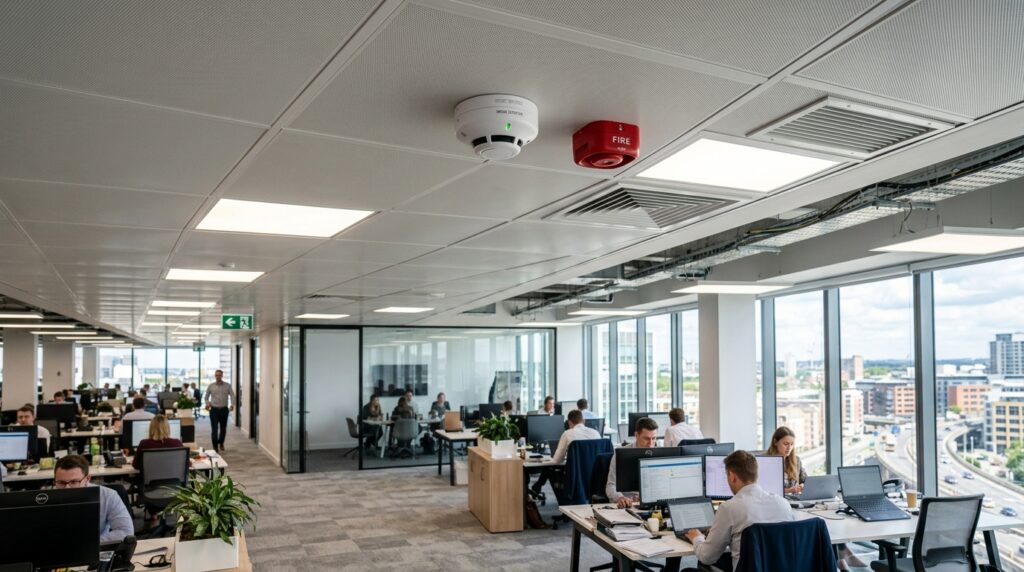
There are several types of fire alarm systems available for commercial buildings, and the right choice depends on factors such as building size, occupancy, layout, fire hazards and the findings of a suitable fire risk assessment.
The main options include conventional, addressable, wireless and hybrid systems, while different detector technologies and BS 5839 categories determine how fire is detected and what level of protection is provided.
A commercial fire alarm system is designed to detect fire and provide early warning so that people can evacuate and emergency action can begin. Some systems require occupants to activate an alarm manually, while others use automatic fire detection.
For businesses, choosing between different types of fire alarm systems is not simply a matter of selecting the newest technology. The system needs to match the building’s fire risks, escape routes and operational requirements.
Proforce Security has provided professional security solutions in the UK since 2007 and holds SIA Approved Contractor status for protecting people, properties and business operations.
What Are the Different Types of Fire Alarm Systems?
Fire alarm systems vary considerably in complexity. A small commercial premises may need a relatively straightforward arrangement, whereas a large warehouse, office complex, industrial site or multi-storey building may require a more sophisticated network.
Fire alarm systems can be classified as manual, life protection, and property protection. They can also be distinguished by the technology used to detect and communicate a fire.
The main types of fire alarm systems used in commercial settings include:
- Conventional fire alarm systems, which divide a building into detection zones.
- Addressable fire alarm systems, which identify individual devices and provide more precise information about an alarm.
- Wireless fire alarm systems, which communicate using radio frequencies instead of conventional cabling.
- Hybrid fire alarm systems, which combine wired and wireless components.
- Analogue addressable systems, which continuously assess information from detectors and provide more detailed monitoring.
These options form the foundation of modern commercial fire alarm systems, but the detectors installed within them are equally important.
Conventional Fire Alarm Systems
A conventional fire alarm system divides a commercial building into zones. Smoke detectors, heat detectors, manual call points and other devices are connected to the relevant zone, with the fire alarm control panel indicating which zone has triggered an alarm.
This means the system can identify the general area where an incident has occurred, but it does not normally identify the exact detector responsible. For a smaller building with a straightforward layout, this may provide an effective and practical solution.
Conventional fire alarm systems are cost-effective for small premises. They can be suitable for smaller offices, shops, workshops and other commercial properties where precise device-level identification is less important.
Addressable Fire Alarm Systems
An addressable fire alarm system gives individual devices their own address. When a detector activates, the fire alarm control panel can identify the specific device that has detected a potential fire rather than simply displaying a general zone.
Addressable fire alarm systems indicate the exact location of a fire. This can help occupants, security personnel and emergency responders understand where attention is required, particularly in larger commercial buildings.
An addressable fire alarm system can also provide information about faults, detector status and other system conditions. This makes addressable technology particularly useful where a building contains numerous rooms, floors or areas with different fire risks.
Analogue Addressable Fire Alarm Systems
Analogue addressable fire alarm systems continuously evaluate environmental conditions. Instead of treating every detector as simply active or inactive, the system can assess information received from individual devices and communicate it to the control panel.
This can support more detailed fire detection and help identify changing conditions before they develop into a confirmed fire. The technology can therefore be valuable in commercial environments where early warning and detailed system information are important.
Wireless Fire Alarm Systems
A wireless fire alarm system uses radio communication between detectors, call points and other devices instead of relying entirely on physical cables. Wireless fire alarm systems communicate via radio frequencies instead of cables.
This approach can be particularly useful when installing a new system in an existing building where extensive cabling would be disruptive, expensive or difficult. It may also be considered for buildings where preserving existing structures or finishes is important.
Wireless systems can provide flexibility when a building is being refurbished or its layout is likely to change. Devices can be positioned where they are needed without the same dependence on fixed cable routes as a fully wired installation.
Hybrid Fire Alarm Systems
A hybrid fire alarm system combines wired and wireless components within the same fire detection arrangement. This can be useful where some areas of a commercial building can be cabled easily while others present installation challenges.
For example, a business may have a modern office extension alongside an older section of the building. A hybrid arrangement could allow wired devices to be used where cabling is straightforward while wireless devices are considered for areas where installation would otherwise cause greater disruption.
The choice between these types of fire alarm systems should always follow an assessment of the building rather than being based solely on installation convenience.
Fire Detection Types Used in Commercial Buildings
The choice of detector is an important part of designing commercial fire detection systems. Different areas of a building can present different fire risks, so detectors should be selected according to the expected type of fire, environmental conditions and the required response time.
The main detection options include smoke detectors, heat detectors, multi-sensor devices and specialist equipment such as aspirating smoke detection and flame detectors. Combining appropriate detection technologies can help provide earlier warning while reducing unnecessary or false alarms.
Smoke and Heat Detectors
Smoke detection is commonly used where a developing fire is expected to produce smoke before significant heat reaches the detector. Smoke detectors can provide early warning, allowing occupants more time to respond and use designated escape routes.
Heat detectors operate differently. They respond when the temperature reaches a specified level or rises rapidly. They can be useful in areas where smoke, dust, steam or fumes could cause unwanted alarms from conventional smoke detection.
For example, kitchens, workshops and certain industrial areas may have environmental conditions that make standard smoke detection less suitable. A suitable fire detection system should therefore consider the conditions in each individual area.
Multi-Sensor Detection
Multi-sensor detectors combine information from more than one detection technology, such as smoke and heat. This allows the system to assess several indicators before determining whether an alarm condition exists.
They can be useful in commercial environments where reducing false alarms is important while still providing effective early detection. The appropriate detector should be selected according to the specific fire risks and environmental conditions identified during the fire risk assessment.
Aspirating Smoke Detection
Aspirating smoke detection systems actively draw air for early smoke detection. Rather than waiting for smoke to reach a conventional detector naturally, the system samples air from the protected area and analyses it for signs of combustion.
This technology can provide very early warning and may be considered for environments where even a small delay in detection could have serious consequences. Examples can include data centres, communications rooms, warehouses and areas containing sensitive equipment.
Flame Detectors
Flame detectors are specialist devices designed to identify the radiation produced by flames. They can be appropriate for certain high-risk environments where fires can develop rapidly and where smoke or heat detection may not provide the earliest possible warning.
They may be considered in specific industrial settings involving combustible liquids, gases or other significant fire hazards. Flame detectors are not a universal replacement for smoke or heat detection, so their use should be based on a sufficient fire risk assessment.
Understanding Fire Alarm Categories
One of the most important distinctions when comparing types of fire alarm systems is the difference between the physical system and its protection category.
BS 5839 standards classify fire alarm systems based on their protection purpose. In broad terms, L categories focus on life protection while P categories prioritise property protection.
Fire alarm categories include M, L1, L2, L3, L4, L5, P1, and P2. Category M relates to manual activation, L categories relate primarily to life protection and P categories relate to property protection.
Category M: Manual Fire Alarm System
Category M is a manual fire alarm system where occupants activate the alarm when they discover a fire. Category M systems require manual activation by occupants.
Manual call points are positioned throughout the relevant premises so that people can raise the alarm without relying on automatic detectors.
Category M systems are manual and often used in low-risk areas. However, the suitability of a manual system depends on the building’s fire risk, occupancy and applicable requirements. A manual system does not provide the same automatic detection capability as an arrangement incorporating smoke or heat detectors.
Category L1: Maximum Life Protection
Category L1 provides the highest level of automatic life protection within the L category framework. These systems provide maximum life protection with full coverage.
Under an L1 arrangement, automatic detection is generally provided throughout the building, subject to the detailed requirements applicable to the premises and system design. L1 systems provide maximum life protection with detectors in all areas.
The objective is to provide the earliest possible warning of fire, helping people respond quickly and evacuate before conditions become dangerous.
Category L1 maximum life protection may be considered where the consequences of delayed detection could be particularly serious. The exact requirement should be established through a competent assessment rather than assuming every commercial building requires L1.
Category L2: Additional Life Protection
L2 systems provide additional life protection in high-risk areas. This category includes detection in escape routes together with automatic detection in specified areas where a higher fire risk exists.
L2 category offers life protection in addition to specific higher-risk areas.
Examples may include rooms or areas where a fire could develop more quickly or where a fire could present a particular threat to occupants. The areas requiring additional detection should be identified through the fire risk assessment and the relevant design standard.
For businesses, L2 can therefore provide a balance between standard escape-route protection and additional detection in areas where particular fire risks have been identified.
Category L3: Standard Life Protection
L3 systems are intended to provide standard life protection by giving occupants sufficient warning to evacuate safely. These systems feature detectors along escape routes for standard life protection.
The purpose is to detect a developing fire early enough to provide occupants with adequate warning before escape routes become compromised.
Depending on the building and its design, detection may also be required in rooms opening onto escape routes or other relevant areas. The exact coverage should always be determined by the building’s characteristics and applicable requirements.
Category L4: Modest Life Protection
Category L4 provides a more limited form of automatic life protection than L1, L2 or L3. These systems only place detectors along escape routes. The focus is on providing warning to people using designated escape routes rather than providing automatic detection throughout the building.
L4 modest life protection may be appropriate for certain lower-risk premises where a risk assessment supports this level of protection. It should not simply be selected because it is less extensive or potentially less expensive than a higher category.
Category L5: Localised Life Protection
L5 is designed around a specific fire risk identified within a building. L5 localised life protection therefore does not represent a standard level of coverage across an entire premises.
Instead, additional detection is provided in a particular area where a specific fire hazard requires extra protection. Category L5 localised life protection can therefore be useful where a particular room or activity presents a fire risk that is not adequately addressed by the building’s wider detection arrangement.
For example, a high-risk room may require additional detection because of its contents, equipment or activities. The exact requirement should be determined through a sufficient fire risk assessment and appropriate professional design.
Category P1: Maximum Property Protection
Category P systems focus on protecting property rather than providing a particular level of life protection.
P1 systems detect fires throughout the entire building. Category P1 maximum property protection is intended to provide comprehensive automatic detection so that a fire can be identified as early as possible.
Early detection can help businesses take action before a fire spreads and minimise fire damage. This can be particularly relevant for buildings containing valuable equipment, stock, records or other assets.
Category P2: Additional Property Protection
P2 provides automatic fire detection in specified areas rather than throughout the entire building. It can be used where the primary property protection objective relates to particular rooms, assets or fire risks.
The areas requiring detection should be established through an assessment of the property’s vulnerabilities and the consequences of fire.
Property protection systems should not be confused with life protection categories. A business may have requirements relating to both people and property, and the overall fire alarm system should reflect those objectives.
Fire Alarm Grades and System Grades
Fire alarm grades are another term that can cause confusion because grades and categories describe different aspects of a fire alarm arrangement.
Fire alarm grades range from A to F. Fire alarm grades indicate system quality and complexity. Grade A systems require compliance with BS5839 standards. Most domestic homes use fire alarm grades D to F. Commercial properties typically require grades A to C.
However, grades should not be treated as a simple ranking from “best” to “worst”. They describe the type and level of system arrangement rather than automatically identifying which system is appropriate for a particular building.
Fire alarm system categories and grades should not be used interchangeably. Categories such as L1, L2 and P1 describe protection objectives, while grades relate to the configuration and standard of the system.
How the Right Fire Alarm Category Is Selected

There is no single option that suits every commercial property. The appropriate fire alarm system depends on the building’s size, occupancy, layout, use and fire risks.
A proper assessment should consider:
- The number of occupants and how they use the building.
- The building’s escape routes and travel distances.
- Areas containing significant fire hazards.
- Whether people may be asleep, unfamiliar with the premises or otherwise vulnerable.
- The value and importance of equipment, stock and other assets, identified through a security risk assessment.
- Existing fire detection equipment and infrastructure.
- Whether the building is new, being refurbished or already occupied.
- The need for early warning, security alarm systems and fire alarm monitoring.
- The potential consequences of false alarms.
The right fire alarm system should then be designed around these factors. Choosing between the different types of fire alarm systems is only one stage of the process. The detection method, category, system configuration and ongoing maintenance all need to work together to provide effective fire safety.
Fire Alarm Installation, Testing and Monitoring
Professional fire alarm installation is essential because even suitable equipment can provide inadequate protection if detectors, alarm devices or the control panel are incorrectly positioned or configured.
Once installed, commercial fire alarm systems require regular inspection, testing and maintenance. Routine checks help identify faults, damaged devices, battery problems and other issues before they affect system performance.
A fire alarm monitoring system can provide an additional layer of protection by transmitting alarm signals to a monitoring centre. This can be particularly useful for premises that need a response to an alarm outside normal working hours.
Businesses should also maintain appropriate testing and maintenance records and ensure that any faults are addressed promptly.
Strengthen Fire Safety with Waking Watch and Alarm Response
A suitable commercial fire alarm system can provide early warning, but businesses also need a reliable response when an alarm is activated.
Proforce Security provides 24/7 key holding and alarm response, with a control centre that receives alarm notifications and dispatches licensed security officers to investigate, secure the premises and contact emergency services where necessary.
For buildings requiring continuous on-site fire monitoring, we also provide a Waking Watch service, giving businesses an additional layer of protection alongside their existing fire safety arrangements. Get in touch with our team to learn how we can strengthen your building’s fire safety arrangements.
FAQs About Commercial Fire Alarm Systems
Which fire alarm system is best for commercial buildings?
There is no single best option for every building. Conventional systems may suit smaller premises, while addressable systems can be more suitable for large or complex buildings. Wireless and hybrid systems may be useful where cabling is difficult.
What is the difference between addressable and conventional fire alarms?
A conventional fire alarm identifies the zone where an alarm has been activated, whereas an addressable system can identify the individual detector or device. This can make addressable systems easier to manage in larger premises.
What is an L1 fire alarm system?
An L1 system provides maximum life protection with automatic detection throughout the building, subject to the applicable design requirements. It is intended to provide the earliest possible warning of fire.
What is an L2 fire alarm system?
An L2 system provides additional life protection by covering escape routes and specified higher-risk areas. The areas requiring additional detection should be established through the building’s fire risk assessment.
What is BS 5839?
BS 5839 is a series of British Standards covering the planning, design, installation, commissioning and maintenance of fire detection and fire alarm systems. Different parts address different types of premises and systems.
Are commercial fire alarm systems legally required?
Fire safety requirements depend on the type of premises, its use and the risks present. Businesses should comply with applicable fire safety regulations and carry out an appropriate fire risk assessment to determine the necessary measures.
How often should commercial fire alarm systems be tested?
Commercial fire alarm systems should be regularly inspected, tested and maintained in accordance with the relevant standards and system requirements. Testing arrangements should be established by a competent professional and appropriate records retained.
What is a fire alarm monitoring system?
A fire alarm monitoring system transmits alarm or fault information to a monitoring centre. This can allow an appropriate response to be initiated when an alarm occurs, including outside normal business hours.
How much does a commercial fire alarm system cost?
The cost varies according to the building’s size, number of devices, system type, cabling requirements, detection technology and installation complexity. A site assessment is normally needed to provide an accurate quotation.


