
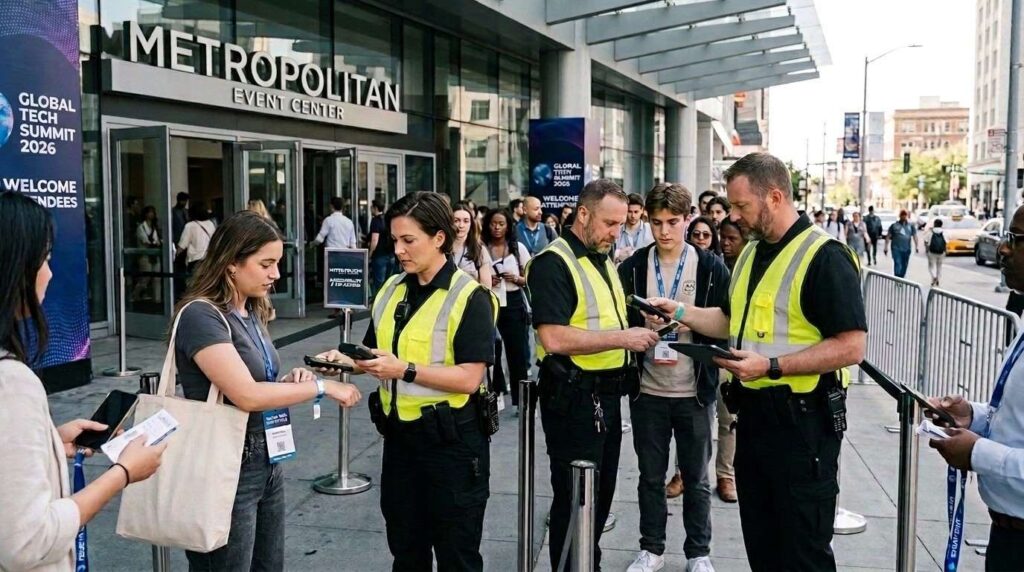
Calculating how many security guards per person you need is one of the first practical decisions any UK business owner or event organiser faces. Get the ratio wrong and you risk either compliance failures or wasted budget.
There is no universal UK law for security guard ratios. Actual numbers come from risk assessments, premises licence conditions and local authority requirements. A 1:100 ratio is a starting point for low risk events. Standard events with alcohol typically need around 1 guard per 75 to 100 attendees, while high risk events may require one security guard for every 20 to 30 attendees.
This guide by Proforce Security breaks down the benchmarks, key factors and legal requirements so you can plan with confidence.
How Many Security Guards Per Person You Need in the UK?
Most owners ask us “how many security guards does my business need for an event?” So, let’s answer it in detail.
For most UK events, plan for one security guard per 100 to 150 guests at low risk, 1 per 75 to 100 at standard risk, and 1 per 50 or fewer at high risk. Offices and commercial sites calculate manned guarding needs by entrance count, square footage and operating hours rather than a simple per-person formula.
Professional security guard staffing levels depend on the venue and level of risk. Attendance numbers significantly influence security guard requirements, but these benchmarks are planning starting points. The actual number of security guards must follow a thorough risk assessment and, where applicable, your premises licence conditions set by the local authority.
Standard Security Guard Ratios: How Many Guards Per Person?
UK security practice uses broad guard-to-attendee ranges rather than rigid law. Crowd size directly influences the number of security guards needed, but the appropriate ratio varies depending on whether you are running a seated seminar or a late-night music festival. These benchmarks come from industry practice, insurer expectations and UK government events guidance not from a single statute.
Event & Venue Security Ratios (Guard-to-Guest Calculations)
Event organisers typically start by asking how many security guards for an event they need, then refine based on event type, crowd profile and local requirements. Security staffing for public events varies widely depending on crowd size and alcohol availability.
- Low risk events (seated conferences, AGMs, daytime trade shows): one event security guard is recommended for every 100 attendees. With controlled entry, no alcohol service and a calm audience profile, some organisers stretch to 1:150.
- Medium risk events (weddings, community gatherings, evening receptions): one guard per 50 people is recommended for medium-risk events. Where alcohol consumption is moderate and guests move between seated and standing areas, a ratio of 1:75 to 1:100 is common.
- High risk events (music festivals, late-night venues, sports screenings): high risk events may require one guard for every 20 to 30 attendees. High-density crowds and late-night operations typically call for more security personnel, and crowd demographics affect the necessary security presence.
Events serving alcohol, with open public access, or featuring pyrotechnics and temporary structures often push staffing well beyond ballpark figures. VIP events or high-profile situations can require tighter security ratios like 1 guard per 10 to 20 attendees.
Commercial & Office Premises Ratios (Footprint vs Headcount)

Businesses often ask how many security guards per person they need in their office or warehouse, but for static sites the more accurate method is guard-per-entrance and patrol coverage. Venue layout affects the number of security guards required far more than employee headcount alone.
- Multi-tenant offices: 1 guard per main public entrance, plus a roaming patrol for every 5,000 to 10,000 sq ft. For smaller office buildings, a common ratio is 1 guard per 50 to 100 people based on visitor flow.
- Large commercial spaces: Commercial security employs 1 guard per 100 to 250 people due to multiple access points, with coverage adjusted for reception, loading bays and car parks.
- Warehouses and logistics hubs: at least one gatehouse guard for vehicle access plus one yard or perimeter patrol per shift, regardless of how many employees are on site.
- Mixed-use sites: areas with licensed bars or cafes may need SIA Door Supervisors, while back-of-house relies on standard security operatives.
Visible presence matters for deterrence and staff reassurance, but coverage of entry points and exit points remains the primary calculation.
Key Factors That Determine Security Staffing Requirements
How many security guards per person you ultimately need is driven by several factors beyond simple headcount. Risk assessments should guide security planning and staffing strategies, and a risk assessment identifies potential security threats specific to your site or event.
- Access points and entry control: each public entrance, staff door, loading bay and emergency exit may require a dedicated static post. Access control measures like bag checks require dedicated security personnel, adding staff beyond the base ratio.
- Alcohol licensing and crowd dynamics: alcohol consumption increases the need for security personnel. Alcohol service typically increases security needs, often tightening the guard ratio. Events with alcohol typically need more security personnel than equivalent dry events of the same crowd size.
- Site layout and blind spots: multi-storey buildings, long corridors, external yards and remote car parks make a single guard-per-person figure misleading. Guards must cover physical ground, CCTV blind spots and high-value zones.
- Shift rotations and 24/7 coverage: continuous operations, welfare breaks and lone-worker rules mean you may need 4 to 5 security guards to staff a single 24/7 post across a full week.
- Historical incident data and insurance: previous theft, assaults, unauthorised entry or near misses, plus insurer recommendations, push ratios higher. These identified risks override any general rule of thumb.
SIA Compliance & UK Legal Requirements for Security Ratios
While the Security Industry Authority does not publish a national ratio, it does regulate who can legally perform guarding and door supervision in the UK. Any calculation must only count properly licensed officers for licensable activities.
- SIA licensing rules: anyone performing manned guarding services, door supervision or public-facing event security must hold a valid SIA licence. With over 517,000 active licences in the UK, the regulated workforce is substantial.
- In-house vs contracted guards: most contracted security guards performing licensable activities must hold an SIA licence. Some tightly defined in-house roles may be exempt, but the distinction rests on function, not employer.
- Risk assessments and local council mandates: local regulations and venue specifics should be considered when planning security staffing. A premises licence can set minimum security requirements, and Safety Advisory Groups can mandate operative numbers that override generic advice. The Licensing Act of 2003 governs security requirements for alcohol service at licensed premises.
There is no universal UK law for security guard ratios, but the combination of health and safety obligations, licence conditions and insurer expectations effectively creates binding minimums for certain events and venues.
Manned Guarding Staffing Estimator: Business vs Event Setup
Use the table below as a starting framework. These are indicative benchmarks, not strict rules.
| Operational Scenario | Primary Calculation Metric | Recommended Minimum Staffing |
| Corporate office or commercial building | Access points and visitor volume | 1 guard per main entrance + 1 rover per 5,000 sq ft |
| Warehouse or logistics hub | Perimeter gates and loading bays | 1 gatehouse officer + 1 yard patrol per shift |
| Low risk private event or seminar | Guest headcount | 1 SIA guard per 100 to 150 attendees |
| Standard event with alcohol | Guest headcount + risk factors | 1 SIA guard per 75 to 100 attendees |
| High risk venue, festival or concert | Guest headcount + alcohol + late finish | 1 SIA Door Supervisor per 50 attendees (or tighter) |
Professional security services providers like Proforce Security refine these figures after reviewing floor plans, licence conditions and event risk assessment data.
Event Security Ratios for Different Risk Levels and Event Types

Event organisers often struggle to translate generic advice into real numbers for their specific event. Here is how security for event ratios map to common UK scenarios.
- Low risk events: shareholder meetings, training days, local awards evenings. One guard per 100 to 150 guests is usually adequate. Calm, seated formats with minimal alcohol keep security requirements low.
- Medium events: evening receptions, weddings, student balls, Christmas parties. Around 1 guard per 75 to 100 guests, adjusting upward if guests are standing, dancing and moving between areas. Events serving alcohol may require more security personnel than the base ratio suggests.
- Large events at high risk: live music gigs, public fireworks, multi-zone festivals. One guard per 50 guests or more, plus stewards and supervisors for crowd management and emergency egress. A standing concert with dense crowds may need even tighter coverage at stage-front.
Worked example: a 400-person mixed-risk event might nominally need 4 guards at 1:100, but actually requires 7 to 9 when multiple entrances, bag searches, backstage, a control room and response duties are listed separately.
Event security staff plans must be validated against premises licence conditions and local authority expectations, not just a chosen ratio.
Practical Examples: How Many Security Guards Per Person for Common Scenarios
- 100-person daytime seminar in a hotel meeting room, no bar: 1 SIA guard at reception plus venue staff support. Roughly 1 guard per 100 people, a safe environment for a predictable crowd.
- 250-person evening wedding with full bar, DJ and dance floor: 3 to 5 SIA Door Supervisors depending on entry points and bar locations. The base 1:75 ratio provides a starting point, but crowd behaviour around the dance floor and late finish push numbers higher.
- 500-person standing concert in a city-centre venue serving alcohol: a base 1:50 ratio indicates about 10 guards, but stage-front, backstage, search lines and a control room may push the security team to 12 to 15 operatives. More security guards are needed where crowd control is intensive.
- 300-staff office over several floors: one or two reception guards, one patrol officer and out-of-hours cover. This does not map to a neat per-person figure but ensures all entry points and a safe environment are covered.
These examples show why hiring private security contractors with professional input is more reliable than relying on online calculators alone, and why it is sensible to consider .
Need an Exact Guarding Assessment for Your Site or Event?
If you are still unsure how many security guards per person your site or event needs, Proforce Security can provide a tailored risk assessment and deployment plan. As an SIA Approved Contractor based in Sheffield with UK-wide coverage, Proforce has delivered appropriate security measures for businesses, venues and event organisers since 2007.
Share your event size, event type, crowd size, venue layout and timings with the team so they can calculate precise staffing per post and per zone. Recommendations always prioritise safety, compliance and operational practicality to ensure the final plan is both defensible and cost-effective.
Request a Security Consultation
Frequently Asked Questions
How many security guards do I need for a 200-person event in the UK?
For a 200-person low risk daytime event, 2 SIA guards (around 1:100) are often sufficient. If the event involves alcohol service, runs late or has multiple entrances requiring searches, plan for 3 to 4 guards. Crowd control duties and event planning complexity may push the number higher still.
Is there a legal minimum number of security guards required for UK businesses?
There is no single statute specifying a fixed ratio. However, UK employers must manage risk under health and safety law. Premises licence conditions, insurer requirements and local council Safety Advisory Group mandates can effectively set minimum staffing expectations for certain venues and large events.
Do in-house security guards need an SIA licence in the UK?
Most contracted guards performing manned guarding or door supervision must hold a valid SIA licence. Some narrowly defined in-house roles may be exempt, but businesses should consult official SIA guidance to confirm before deciding how many security guards to deploy internally.
Can stewards be counted towards how many security guards per person I need?
Stewards can support crowd management, information and wayfinding duties, but cannot replace SIA-licensed security guards for licensable activities such as searches, admission decisions or physical intervention. They should not be included in any strict guard-per-person calculation for legal compliance purposes.
How far in advance should I confirm how many security guards per person my event needs?
Confirm guard numbers at least 4 to 8 weeks before medium to large UK events, once event type, crowd size, venue layout and alcohol licensing details are finalised. This lead time allows your provider to align staffing, briefings and rota planning with the agreed deployment.


