
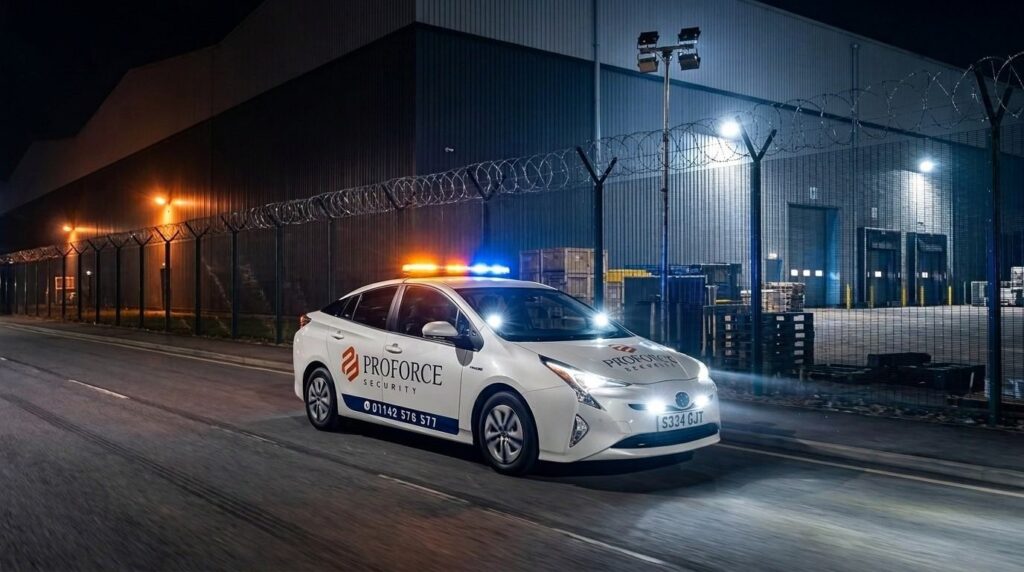
Warehouse crime across the UK is rising, and large logistics sites with sprawling perimeters and overnight blind spots are prime targets.
Mobile patrol security for warehouses uses SIA-licensed officers in marked patrol vehicles to carry out scheduled or random patrols of perimeters, loading bays, and vehicle yards, providing a cost effective solution compared to full-time static guarding.
Mobile patrols reduce security costs while still delivering a visible security presence that deters trespassing, theft, and vandalism across large UK logistics sites. Patrol officers conduct perimeter inspections, trailer seal checks, fleet inspections, and hazard sweeps, recording every visit with GPS and NFC proof of presence technology.
We, at Proforce Security, provide mobile patrol services backed by our SIA Approved Contractor status and over 19 years of operational experience. This guide explains how mobile patrol security for warehouses works, what patrol officers actually check, and how to combine patrols with CCTV and alarm response for reliable out-of-hours protection.
What Is Mobile Patrol Security for Warehouses?
Mobile patrol security for warehouses is a flexible, cost-efficient alternative to static guarding. SIA-licensed mobile patrol officers use marked vehicles to perform randomised perimeter sweeps, loading bay checks, and yard inspections across large distribution and industrial sites where continuous on-site presence is not practical.
This approach suits warehouses, distribution centres, logistics parks, and remote depots. Mobile patrol teams conduct both scheduled and random patrols, checking access points, roller shutters, doors, and secure compounds to deter theft and unauthorised access.
Mobile patrol officers provide regular site checks during nights, weekends, and bank holidays when premises are largely unoccupied and security risks are highest.
The Security Challenges Facing UK Warehouses & Logistics Hubs
High-value stock, busy loading operations, and large outdoor yards across UK regions such as South Yorkshire, the Midlands, and the M1 corridor create a complex threat landscape and you need to choose a reliable mobile patrol security for it.
Modern warehouse security solutions must address theft, trespass, fuel crime, and vandalism without disrupting time-critical logistics operations. Rising industrial crime in 2024 to 2026 makes mobile patrol security for warehouses an increasingly important layer.
Typical sites at risk include e-commerce distribution centres, 3PL hubs, pallet networks, cold stores, and parcel sortation centres located on remote industrial estates.
High-Value Cargo & Stock Vulnerability
Mixed pallets, electronics, branded goods, and fast-moving consumer products held in UK warehouses attract organised thieves. According to the TT Club and BSI 2025 Cargo Theft Report UK cargo theft losses reached approximately USD 149 million in 2024, with facility theft accounting for roughly 16 to 18 per cent of all cargo theft incidents.
Live loading bays, cross-dock areas, and external staging zones are particularly exposed. Trailers left sealed and unattended overnight or across weekends present clear targets: unsealed trailers, broken container seals, and unattended roll cages. Mobile patrol officers can deter theft by regularly checking trailer seals, monitoring suspicious vehicles, and documenting anomalies in stock or vehicle positioning.
Expansive Site Perimeters & Out-of-Hours Blind Spots
Many UK distribution centres exceed 10 to 20 acres, with long runs of palisade fencing, multiple access points, and poorly lit perimeter lines. Average warehouse sizes in major portfolios now exceed 315,000 square feet, and the largest units top 1.1 million square feet.
Blind spots include rear drainage ditches, embankments backing onto public land, railway lines, or canals where intruders can approach unseen.
Static security guards at a single gatehouse cannot practically monitor every metre of fencing outside core operating hours of 06:00 to 22:00. Mobile security patrols systematically drive and walk these perimeters, checking for cut fencing, moved barriers, or tampered locks, recording each check with GPS or NFC tags.
Mobile units cover large perimeters and remote storage areas more effectively than stationary guards.
Trespassing, Vandalism, and Organised Cargo Theft
Current UK trends show targeted theft of copper piping, catalytic converters, diesel fuel, and high-value cargo from parked trailers along logistics corridors such as the M1, M6, and M62. A 2025 BCC survey found that 42 per cent of UK firms experienced some form of crime in the past year, with many incidents going unreported.
Trespassers often test defences first by cutting small inspection holes in fences, forcing minor doors, or scouting CCTV blind spots before attempting a full break-in. Vandalism, arson, graffiti, and malicious damage to vehicle fleets, loading equipment, and commercial security cameras are common.
Random patrols by trained patrol officers interrupt this reconnaissance phase, report suspicious activity, and escalate early warning signs to management and police.
Key Mobile Patrol Sweeps for Industrial & Warehouse Sites

A professional mobile patrol security provider delivers structured site inspections for visible deterrence in external areas: yards, perimeters, loading bays, plant rooms, and car parks. Here is the core operational checklist:
- Perimeter and fencing checks : inspecting palisade fencing, mesh panels, walls, gates, and emergency exits for cuts, damage, ladders, or signs of forced entry. Patrol officers inspect for potential vulnerabilities such as broken fencing or malfunctioning lights.
- Access points and doors : verifying pedestrian doors, roller shutters, fire exits, and dock leveller doors are locked, sealed, and free of obstruction. Mobile patrols help monitor multiple access points on large sites.
- Loading bay and yard patrols : walking and driving around loading docks, staging areas, and trailer rows to confirm vehicle identities, seal integrity, and the absence of unauthorised persons. Mobile patrols monitor loading bays and perimeter fencing.
- Vehicle and fleet inspection : checking HGV cabs, van compounds, fuel tanks, and on-site refuelling points for tampering or siphoning attempts.
- Hazard and facility checks : spotting fire doors propped open, alarm sounder damage, leaking sprinklers, broken lighting columns, or pooling water. Regular inspections can identify security vulnerabilities early.
- Remote corners and overflow areas : prioritising seldom-visited container stacks, empty plots, and redundant dock areas where offenders may hide. Mobile patrols can deter opportunistic theft with a visible presence in these zones.
- Documentation of every sweep : each visit is time-stamped and recorded digitally with photos. Real-time digital reporting provides insights into security operations and incidents, giving warehouse managers verifiable proof that patrols were completed as agreed.
Marked security vehicles and uniformed security officers act as a strong visual deterrent across every sweep.
Scheduled vs Randomised Mobile Patrols for Logistics Hubs
Both scheduled and random patrols play a role in effective patrol security for warehouses. The right balance depends on your site’s risk profile.
When Scheduled Patrols Are Suitable
Scheduled patrols work best for daily lock-up at 20:00, pre-opening checks at 05:30, shift-change supervision, and routine weekend inspections. These can include escorting late-working staff, verifying all roller shutters are lowered, and checking alarm panels before final set. Patrols can include locking and unlocking premises as needed.
When Random Patrol Strategy is Needed
Random patrols vary visit times between, say, 22:00 and 05:00, preventing offenders from predicting patrol patterns. The unpredictable schedule of mobile patrols makes it difficult for criminals to establish a routine. For example: two visits one night at 23:15 and 03:40, then three shorter visits the following night at different times, covering different access points and yard layouts.
How to Decide the Frequency of Patrols?
Optimal frequency should be based on a formal risk assessment, stock values, recent local crime data, and the number of external access points. A blended model works well: scheduled lock and unlock plus a minimum of two to four random patrols during high-risk windows, adjusted for peak seasons such as pre-Christmas volumes.
Mobile patrols can adapt routes based on changing site conditions and risks. Consider flexible patrol schedules tailored to risk levels for the best results.
Integrating Mobile Patrols with CCTV, Alarms & Remote Monitoring
Mobile patrol security for warehouses is most effective when combined with CCTV monitoring, monitored alarm systems, and key holding. Mobile patrols complement CCTV monitoring by adding a physical presence to monitor security across yards and perimeters.
- Integrated protection: CCTV analytics or perimeter beams detect movement around yards or access points, then relay alerts to a monitoring centre that dispatches mobile patrol officers. This is particularly valuable for remote site security where no staff are present.
- Alarm response: when a warehouse alarm activates, the control room contacts the nearest patrol unit. An SIA-licensed officer arrives to complete a full external sweep within agreed response times. Mobile patrols provide rapid response to alarm activations and incidents, acting as the physical verification arm of any remote monitoring setup.
- Verification and escalation: trained security officers verify whether an activation is genuine or false, preserve evidence, photograph the scene, and contact emergency services if a break-in or safety issue is confirmed.
- Proof of presence technology: GPS-tracked vehicles, NFC tags on key perimeter gates, and QR codes at critical plant rooms create an audit trail of patrol routes and timings. Select a provider offering real-time reporting systems so warehouse managers receive digital inspection reports. Regular security checks support risk management and may help fulfil insurance requirements.
- Reporting: incident summaries can be emailed to logistics managers or uploaded into facility management platforms before the next working day.

Mobile Patrols vs Static Guarding for Warehouse Security
Unlike static guarding, mobile patrol security for warehouses is not a replacement for all forms of guarding but a complementary option focused on external sweeps and out-of-hours property protection.
Coverage and focus: mobile security patrol services cover perimeter, vehicle yard, and loading bay checks across multi-acre sites. Static guards concentrate on gatehouse control, access control, and contractor sign-in.
Cost profile: mobile patrol units operate on a shared-fleet, multi-client model, making them highly budget-friendly. Mobile patrols reduce security costs compared to full-time guarding. Static manned guarding demands a dedicated hourly rate per officer. Understanding the benefits, costs and uses of patrols vs static guarding helps warehouses choose the most efficient mix.
Operational flexibility: patrol routes and timings can be quickly adjusted if a warehouse opens a new yard, adds temporary trailers, or faces short-term risks. Mobile patrols can be more flexible and scalable than static guards as warehouse security services. Fixed guards are better suited to high-traffic 24/7 distribution centres.
Best use cases: mobile patrols offer flexible security coverage for out-of-hours depots, low-traffic storage sites, business parks, and regional hubs empty overnight. Very high-traffic national distribution centres may still need static gatehouse security teams plus patrol support. Proforce Security can advise on the right balance after a detailed site survey.
Why Choose Proforce Security for Mobile Patrol Security for Warehouses
Proforce Security is an SIA Approved Contractor based in Sheffield, providing mobile patrol security services for warehouses, distribution centres, and industrial estates across South Yorkshire.
Here’s what makes Proforce a dependable mobile patrol security provider:
- Accreditations: SIA Approved Contractor status for security guarding and key holding, meeting the standards expected by insurers and facilities leads.
- Local knowledge, national reach: familiarity with regional logistics corridors around Sheffield, Rotherham, Doncaster, and along the M1 supports rapid incident response. A wider mobile fleet covers national contracts.
- Technology-enabled patrols: GPS-tracked marked vehicles, digital incident reporting, and real-time control room oversight ensure patrol completion and clear records for clients. Look for providers with proven mobile patrol experience and check for a strong reputation and client references.
- Professional mobile patrols delivered by trained security personnel: 24/7 control room supervision and structured operating procedures for incident escalation. Trained officers ensure your security needs and security priorities are met.
Protect Your Warehouse & Cargo Assets Today
If you manage a warehouse, distribution centre, or vehicle yard, arrange a physical security survey with Proforce Security. We will assess how mobile patrol security for warehouses can be combined with alarm response, CCTV monitoring, and key holding to strengthen property protection across your site or multi-site network.
Our recommendations focus on practical, risk-based improvements rather than unnecessary add-ons, reflecting a safety-first and transparent approach. Mobile patrols help maintain compliance with insurance requirements and reduce both internal and external theft.
Request a Free Site Survey to discuss your security concerns with our team.
FAQs About Mobile Patrol Security for Warehouses
How often do mobile security patrols visit a warehouse site?
Visit frequency in industrial security services is driven by a formal risk assessment considering stock value, recent security incidents, site size, and number of access points. Typical ranges are two to six patrols per night between 20:00 and 06:00, with higher patrol frequency during peak seasons or after specific threats.
Proforce designs bespoke patrol schedules for each warehouse rather than offering a one-size-fits-all pattern. Mobile patrols provide security coverage during out-of-hours operations beyond normal working hours.
Can mobile patrol officers lock and unlock warehouse gates and buildings?
Yes. SIA-licensed mobile patrol officers can provide lock and unlock services, including setting and unsetting intruder alarms, securing roller shutters, and opening main vehicle gates at agreed times. This is typically delivered as part of an integrated key holding and mobile patrol package.
All keys and access fobs are managed under strict chain-of-custody procedures as part of a complete security strategy for your warehouse.
What happens if a mobile patrol officer discovers a break-in at a distribution centre?
The officer moves to a safe position, informs the control room, and requests police attendance while monitoring the scene without entering unsafe areas. Officers then support emergency services, help secure the perimeter, and provide a detailed written incident report with photos for management and insurers.
Proforce follows SIA guidelines and internal emergency protocols during all such security incidents, ensuring you can respond quickly and effectively.
Can mobile patrol security integrate with our existing CCTV and alarm systems?
Mobile patrol security for warehouses is integrated with third-party CCTV and alarm systems, whether monitored on-site or by a remote ARC. Proforce can work with existing installers to define response protocols, access routes, and verification steps. Any limitations or blind spots identified during patrols are fed back to improve overall security measures and identify vulnerabilities across your site.
This makes mobile patrols a natural part of any broader security strategy.
Is mobile patrol security suitable for multi-site warehouse networks?
Mobile patrol services provide particularly effective coverage for operators with several smaller depots, satellite warehouses, and other commercial properties.
Patrol officers can visit multiple locations in a single shift, with routes planned to cover each site’s high-risk periods. This multi-site model keeps costs controlled while delivering a visible deterrent and rapid response capability. Mobile patrols offer flexible security coverage and can cover multiple sites efficiently, making them an ideal security partner for growing logistics networks.


