
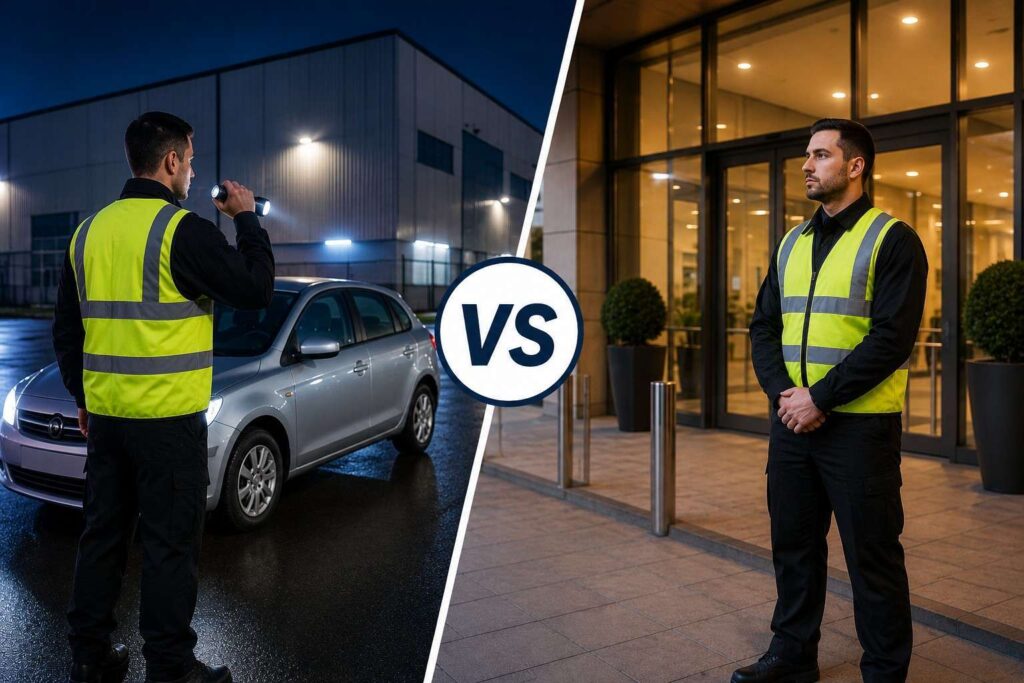
Businesses across the UK face a wide range of security challenges, from theft and vandalism to unauthorised access and damage to valuable assets. One of the most common questions businesses ask is whether a security patrol offers better value than static guarding.
Although both services aim to protect premises and reduce security risks, they operate in different ways. Security patrol services focus on proactive monitoring by conducting scheduled or random inspections across one or more locations.
Static guarding, on the other hand, places dedicated security guards at a fixed position for a constant visible security presence and responds immediately to incidents as they occur.
The right choice depends on several factors, including the size of your site, the level of risk, your budget, operating hours, and the type of protection your business requires. Many organisations combine the both approaches to create a layered security strategy that balances cost with protection.
At Proforce Security, businesses have trusted our professional security services since 2007. In this guide, we’ll compare security patrol and static guarding in detail, explaining how each service works and how to determine which option is best suited to your organisation.
What Is Mobile Security Patrol?
A security patrol is a proactive security service in which trained security officers carry out regular inspections of designated areas to identify potential threats, deter criminal behaviour, and ensure a site remains secure. It can be conducted on foot or by vehicle, depending on the size and layout of the premises.
Foot patrols involve guards walking predetermined areas, making them ideal for inspecting internal spaces, car parks, entrances, and vulnerable access points. In contrast, mobile patrols use vehicles to cover larger areas quickly, making them particularly effective for industrial estates, logistics hubs, retail parks, and construction sites.
What Is Static Guarding?
While a security patrol is designed to move around a site and identify risks proactively, static guarding provides continuous protection from a fixed location.
A static security guard remains on-site throughout their shift, offering a constant visible security presence and acting as the first point of contact for employees, visitors, contractors, and emergency responders. This makes static manned guarding effective for premises that require permanent supervision or a high level of access control. Typical duties include:
- Controlling access to the premises by checking identification and authorising visitors.
- Monitoring entrances, exits, reception areas, and other vulnerable access points.
- Conducting internal inspections to identify security issues or safety hazards.
- Responding to alarms, emergencies, and suspicious behaviour.
- Recording observations through accurate incident reports and daily activity logs.
- Working closely with site management and emergency services when incidents occur.
Because static guards remain at one location for extended periods, they are often able to identify unusual behaviour more quickly than someone unfamiliar with the site.
Mobile Security Patrol vs Static Guarding: Key Differences

Choosing between a security patrol and static guarding is rarely a question of which service is better. Instead, it comes down to which solution best matches your site’s layout, operational hours, level of risk, and budget. Let’s compare their characteristics to find out.
A security patrol is designed to provide proactive, flexible protection across one or more locations. Officers move throughout a site or between multiple premises, carrying out regular security patrols, checking vulnerable areas, and responding to alarms or suspicious activity. Static guarding, by comparison, provides a dedicated on-site presence where a guard remains in one location throughout the shift, continuously monitoring the premises and controlling access.
The table below highlights the main differences between the two services.
| Feature | Security Patrol | Static Guarding |
| Coverage | Covers multiple buildings or large sites through scheduled and random patrols | Protects one designated location continuously |
| Security Presence | Highly visible but intermittent | Constant visible presence throughout the shift |
| Response to Incidents | Patrol officers investigate alarms and suspicious activity quickly | Immediate on-site response from a guard already at the premises |
| Cost | Generally more cost-effective for multiple sites | Higher staffing cost due to permanent deployment |
| Flexibility | Patrol frequency and routes can be adjusted to suit changing risks | Less flexible once shifts are assigned |
| Best Suited For | Warehouses, construction sites, vacant properties, retail parks and business estates | Offices, schools, hospitals, reception areas and high-risk facilities |
| Access Control | Periodic checks of entrances and exits | Continuous management of visitors and access points |
| Scalability | Easily expanded across several locations | Requires additional guards for each new site |
Both services are delivered by trained security officers, but they differ in how they protect premises, respond to incidents, and support day-to-day business operations.
Coverage and Site Visibility
A security patrol is ideal for businesses with large premises or multiple locations because officers can move efficiently between designated areas. Mobile patrols use planned routes to inspect vulnerable locations while random patrols introduce unpredictability, making it more difficult for criminals to identify routine patterns.
Static guarding is better suited to locations where continuous supervision is essential. A permanent guard at a reception desk, gatehouse, or control room ensures that someone is always available to monitor activity, greet visitors, and respond to concerns without delay.
Crime Prevention and Deterrence
Both services play an important role in preventing crime, but they achieve this in different ways.
A security patrol creates uncertainty for potential offenders. Criminals are far less likely to target a property when they know trained officers could arrive at any time. Regular patrolling improves the feeling of security among employees and customers, while the movement of patrol vehicles or foot patrols reinforces the impression that the site is being actively monitored.
Static guards rely on continuous visibility. Their permanent presence sends a clear message that the property is professionally protected. For locations with regular public access, such as offices, residential developments or healthcare facilities, this constant reassurance can be just as valuable as preventing crime itself. Employees, visitors and clients often feel more confident knowing experienced security personnel are immediately available if assistance is required.
Response Time
Response capability is another important consideration.
Because static guards are already on-site, they can respond immediately to security incidents, medical emergencies, unauthorised access, or disturbances. They can secure affected areas, assist occupants, and coordinate with the emergency services while maintaining order.
A security patrol also offers an excellent response capability, particularly when combined with key holding and alarm response services. Patrol officers can quickly investigate alarms and suspicious activity, often reaching different parts of a large site faster than a static guard restricted to one location. In many situations, mobile patrol units can arrive at the scene faster than traditional security guards, especially when protecting several nearby client sites.
Operational Flexibility
Business requirements often change throughout the year. Construction projects progress, retail demand increases during seasonal periods, and vacant properties may only require occasional inspections.
This is where a security patrol offers a clear advantage. Patrol schedules can be increased, reduced, or altered with minimal disruption. Businesses can arrange additional patrols during weekends, bank holidays, night shifts, or periods of increased risk without committing to permanent on-site staffing.
Static guarding is generally less adaptable because each additional shift requires another trained officer. While this provides consistency, it can also increase operational costs where continuous supervision is not essential.
Cost and Value
Cost is often one of the deciding factors for businesses selecting a security solution.
A security patrol is usually the more economical option for organisations with multiple sites or lower-risk premises. Instead of assigning a dedicated guard to every location, one patrol team can protect several properties throughout a shift, providing excellent value while maintaining a strong security presence.
Static guarding represents a greater financial commitment because each site requires its own dedicated security officers and constant onsite presence increases the cost of manned guarding. However, for high-risk environments where access must be monitored continuously or where immediate intervention is essential, the additional investment is often justified.
Which Option Is Better?
There is no single answer because every organisation has different security needs.
A security patrol is often the better choice when you need to protect large areas, multiple premises, or vacant properties in a cost-effective way. Its flexibility, proactive approach, and ability to cover more ground make it particularly suitable for businesses looking to deter crime while keeping costs under control.
Static guarding is generally the stronger option where continuous supervision, customer interaction, or strict access management is required. Businesses that welcome visitors throughout the day or operate in high-risk sectors often benefit from having dedicated security guards permanently on-site.
For many UK companies, the most effective approach is not choosing one service over the other but combining both. A static guard can manage reception, visitor access, and day-to-day security, while a security patrol carries out external inspections, perimeter checks, and out-of-hours patrols. This layered approach provides comprehensive protection and allows businesses to respond to a wider range of risks without compromising operational efficiency.
Advantages and Disadvantages of Each Security Solution
Both security patrols and static guarding can protect people, property and business operations, but they serve different security needs. The right solution depends on your site size, risk level, budget and whether your company requires continuous supervision or flexible coverage.
Advantages of a Security Patrol

- Covers larger areas: Mobile patrol officers can check multiple buildings, car parks, boundaries and vulnerable areas during one shift.
- Offers flexible protection: The security team can adjust patrol routes and timings for nights, weekends, holidays or higher-risk periods.
- Deters criminal activity: Visible and unpredictable mobile patrols deter crime and make it harder to identify security gaps.
- Spots issues early: Officers can check doors, gates, fencing, lighting, security systems and health and safety concerns.
- Improves accountability: Guard patrol systems and security guard tour systems can verify checkpoint visits.
- Supports electronic records: RFID and NFC checkpoints can record patrol activity.
- Provides detailed reports: Officers can document patrols, suspicious activity and incidents.
- Works with remote monitoring: Officers can respond to CCTV and alarm systems alerts. SIA licensing requirements depend on the monitoring activity.
Limitations of a Security Patrol
- No constant supervision: Officers visit the site rather than staying in one location all shift.
- May not suit busy entrances: Sites needing continuous reception, visitor or delivery control may need static guarding.
- Response depends on location: Officers may need to travel to the incident area.
- Needs careful planning: Routes and timings should follow the site’s risk assessment and security protocols.
- Technology can fail: Connectivity, equipment faults or incorrect use may affect electronic records.
Advantages of Static Guarding
- Provides continuous protection: Static guards remain on-site, helping deter crime and reassure staff, visitors and customers.
- Enables quick responses: Guards can immediately respond to unauthorised access, emergencies and alarm systems.
- Strengthens access control: They can check identification and manage contractors and deliveries.
- Builds site familiarity: Regular guards can recognise unusual activity and follow established procedures.
- Supports customer service: Guards can assist visitors while maintaining security.
- Supports health and safety: Trained officers can identify hazards and assist with emergency procedures.
- Creates reliable records: Visitor logs, activity records and incident reports improve accountability.
Limitations of Static Guarding
- Usually costs more: Dedicated staffing means higher pay costs than periodic patrols.
- Covers less ground: One guard cannot continuously monitor entrances, car parks, warehouses and multiple buildings.
- Offers less flexibility: Longer hours or additional locations require extra staffing.
- Needs careful shift planning: Breaks, handovers and absences must be managed properly.
- May not suit lower-risk sites: Some UK companies may achieve suitable protection through mobile patrols, remote monitoring or a combined approach.
Ultimately, neither solution is automatically better. Mobile patrols provide flexibility and wider coverage, while static guarding delivers continuous supervision and immediate on-site support. Many businesses achieve the strongest protection by combining both according to their individual security needs.
Which Businesses Benefit Most from Each Option?
The best security solution depends on your premises, day-to-day operations, and the level of risk your business faces. While some sites benefit from the flexibility of a security patrol, others require the reassurance of a permanent on-site guard, which is why many businesses turn to professional security guarding services in the UK to design a tailored approach.
A security patrol is often the ideal choice for businesses that need regular inspections rather than continuous supervision. It works particularly well for:
- Construction sites
- Warehouses and distribution centres
- Industrial estates
- Vacant and unoccupied properties
- Retail parks
- Residential developments
- Businesses operating across multiple locations
These environments benefit from regular security patrols at regular intervals, helping to deter criminal activity, check external security measures, investigate alerts, and identify maintenance or safety concerns before they escalate.
Static guarding is generally more suitable for premises where a constant security presence is essential, including:
- Office buildings
- Corporate headquarters
- Schools and colleges
- Hospitals and healthcare facilities
- Hotels
- Manufacturing plants
- High-value commercial premises
In these settings, dedicated security officers can manage visitor access, enforce site procedures, respond immediately to incidents, and provide reassurance to employees and visitors throughout the day.
Considerations While Choosing the Security for Your Site
Whichever option you choose, always work with a provider that operates to recognised standards within the UK security industry and holds recognised security accreditations. Security patrol staff must obtain an SIA licence, and the SIA licence is valid for three years. SIA training includes multiple-choice exams and practical assessments, ensuring officers have the practical skills required to carry out their duties safely and professionally.
Depending on the role, CCTV licences also be required for security patrols, while officers working at licensed venues may need a Door Supervisor qualification. The SIA Door Supervisor Licence course lasts six days, and failure to comply with SIA regulations can lead to penalties for both individuals and employers.
Modern security providers also invest in technology to improve accountability. Many patrol operations use QR Patrol software, QR codes, GPS verification, and other physical tags to confirm that patrols have been completed as scheduled. Combined with ongoing training, physical fitness, and first aid awareness, these systems help ensure officers remain physically fit, responsive, and ready to protect your business.
Secure Your Business with Proforce Security Mobile Patrols
Every business has different security requirements, which is why there is no one-size-fits-all solution. Whether you need a flexible security patrol for multiple sites, dedicated static guarding for a high-risk premises, or a combination of both, choosing the right partner is just as important as choosing the right service.
At Proforce Security, we provide tailored security solutions for businesses across the UK. Our experienced, SIA-licensed security officers combine professional expertise with modern technology to deliver reliable protection, rapid response, and complete peace of mind. From professional security services across the UK such as mobile patrols and key holding to static guarding and alarm response, every service is designed around your operational needs and risk profile.
If you’re unsure which option is right for your premises, our team can carry out a professional security assessment and recommend a solution that protects your people, property, and assets without unnecessary cost.
Contact Proforce Security today to discuss your requirements and discover how our professional security services can help safeguard your business.
1. What is the difference between mobile security patrols and static guarding?
Mobile patrol officers move around a site or between locations at scheduled or random intervals, while static guards remain at a designated premises throughout their shift. Static guarding is generally better for continuous access control, while patrols provide broader and more flexible coverage.
2. Do security patrol officers need an SIA licence in the UK?
An SIA licence is normally required when a contracted officer performs licensable private security activities such as guarding premises or property. However, some directly employed in-house security roles are exempt, so the exact requirement depends on the work being carried out.
3. What technology is used in mobile security patrols?
Modern patrols can use guard patrol systems, mobile reporting, GPS tracking, CCTV and electronic checkpoints. RFID or NFC patrol tags can record when an officer reaches a checkpoint, creating a verifiable patrol history and supporting detailed reporting.
4. Which is better, mobile patrols or static security guards?
It depends on the site’s security needs. Mobile patrols are often better for large sites, vacant properties and multiple locations, while static guards suit entrances, receptions and higher-risk premises requiring permanent supervision.


